


The philosophy of "either being the first or the only one" is becoming a shared value among entrepreneurs in the new era. However, faced with limited resources and an industry landscape dominated by giants, how can emerging enterprises achieve differentiated breakthroughs?
Nanjing Aidimai Technology Co., Ltd. (hereinafter referred to as "Aidimai") has provided its own answer: building competitive barriers through technological uniqueness, focusing on the niche track of specialized detection and purification materials, and carving out a "small but refined" development path.
Over the three years since its establishment, Aidimai has leveraged microsphere preparation technology as its core pillar. By innovatively developing integrated solutions for automated detection and purification in life sciences, the company has successfully broken the technological monopoly of imported brands, addressed the shortcomings of traditional technologies, and turned the ideal of "domestic accessibility" into reality.
Developing with "Eyes": Paving the Way for Medical Research Translation
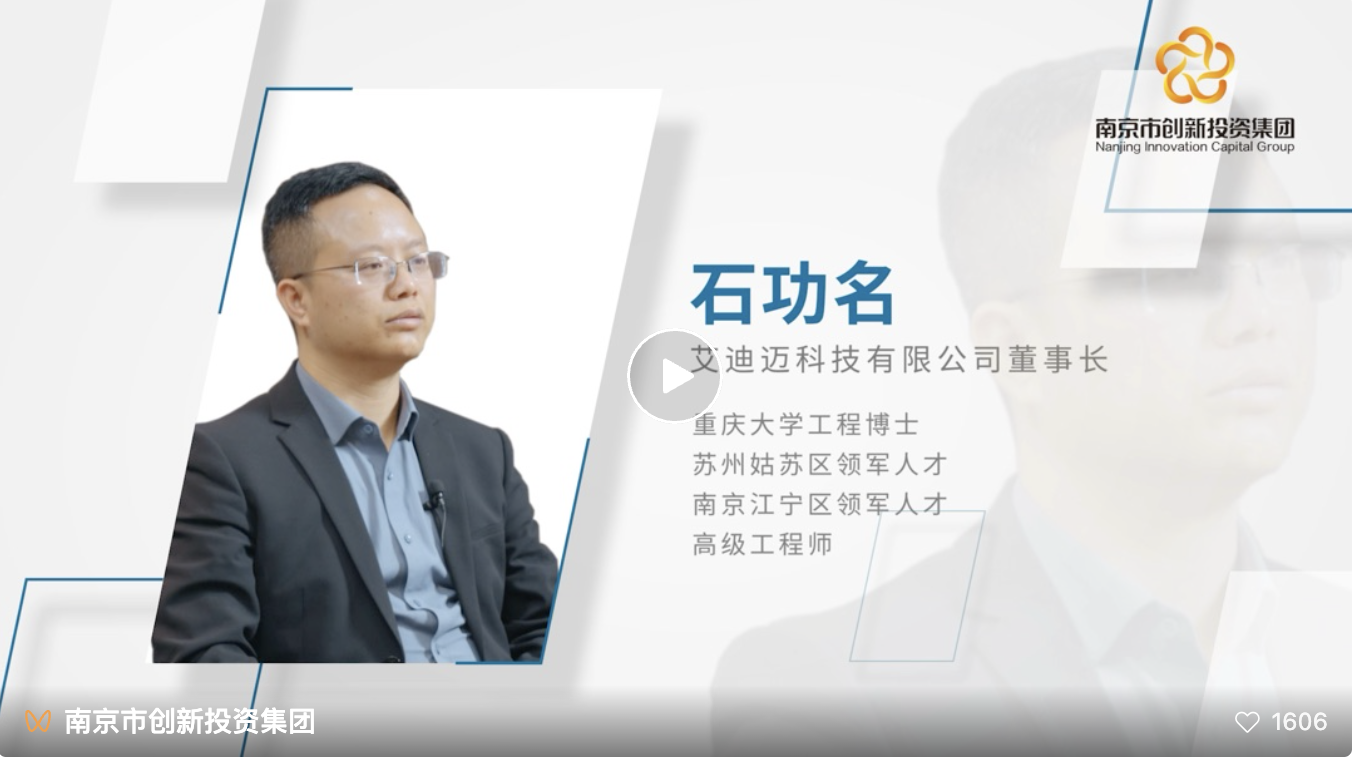
Shi Gongming, founder and chairman of Aidimai, has been persevering on the entrepreneurial path for over eight years.
In 2016, after more than a decade of studying pharmaceutical sciences, Shi co-founded Aividi Biology in Chongqing. Although the company successfully developed and obtained certifications for eight in vitro diagnostic products, with cumulative sales nearing 50 million yuan, he still chose to transfer all his equity and exit the company in 2019.
"Our products achieved technological breakthroughs and completed the first case of domestic substitution, but we hit a development bottleneck due to insufficient market recognition," Shi reflected on this experience, viewing it as a valuable "first lesson in entrepreneurship." To achieve large-scale domestic substitution, technological breakthroughs alone are far from enough. It is essential to simultaneously build three pillars: policy insight, differentiated positioning, and market transformation capabilities, forming a virtuous cycle of technological re-innovation and commercial implementation.
At the end of 2018, Shi participated in a startup pitch event organized by the Suzhou High-Tech District. With a hastily prepared 20-page PPT, he had low expectations of winning. When the list of winners was announced without his project, he had already stood up to leave. Just as he was about to exit, a dramatic moment occurred: the host announced that his project had won the highest award of the event, immediately securing 2 million yuan in startup funding.
The project that captivated the judges was the "R&D and Industrialization of a Fully Automated Therapeutic Drug Monitoring (TDM) System," which was also the focus of Shi's doctoral research.
Like people, drugs have their own "personalities." Some drugs are "easygoing," suitable for almost everyone; others are "picky," only working optimally under specific conditions. TDM technology acts as a "drug dispatcher," analyzing drug concentrations in the blood to achieve the best efficacy with minimal adverse reactions.
In China's medical testing market, awareness of TDM lags significantly behind that in developed countries. Patients often consult doctors rather than pharmacists, leading to lower medication efficacy. "The judges were most impressed by the project's direct addressal of industry pain points—it meets an unmet clinical need while offering the potential for low-cost, accessible healthcare," Shi explained.
Thus, Shi embarked on his "second entrepreneurial journey" in Suzhou, naming the company "Aidimai" (a phonetic translation of ITDM) to promote innovative developments in personalized precision medication. In the early stages, he led the team to establish a magnetic solid-phase extraction pretreatment technology platform and a fully automated two-dimensional chromatography detection technology platform, while simultaneously advancing product development and certification.
"This time, the team adopted a 'clinical demand-driven' R&D model, establishing deep collaboration with hospital pharmacy departments from the very beginning of product design," Shi emphasized. "We developed with 'eyes,' engaging directly with end customers. This allowed us to precisely grasp product positioning, functional needs, and pricing strategies, achieving seamless integration between R&D and the market."
No More 'Using a Cannon to Kill a Mosquito': Redefining Testing Economics
In May 2022, Nanjing Aidimai Technology Co., Ltd. was established, a move Shi considered a critical step for the company's leap forward.
"In Suzhou, we achieved a single-point breakthrough in TDM technology; in Nanjing, we aim to complete a comprehensive upgrade from core technology to industrial ecosystem by integrating microsphere material R&D, equipment manufacturing, and application development," he explained.
Nanjing's unique innovation ecosystem provided ideal conditions for this strategic transformation: abundant university resources helped the company quickly assemble a high-level R&D team, while a well-established investment and financing system supported its growth. In 2022, the company secured angel funding from Dongping Capital (affiliated with Nanjing Jiangning Science and Technology Venture Investment Group) and strategic investment from Nanjing Innovation Investment Group (hereinafter referred to as "Nanjing Innovation Investment Group"). In early 2024, it received Pre-A round funding from Yushan Capital, Navi Microsphere Capital, and Zhongxin Capital.
Over three years in Nanjing, Aidimai has built significant technological advantages. The company now possesses unique underlying microsphere preparation technology and an innovative multi-dimensional chromatography system combining offline and online extraction. It offers comprehensive solutions for the purification and detection of complex matrix products and has established multi-faceted collaborations with several renowned domestic and international companies in technology, application, and market channels.
Among its core products, the fully automated two-dimensional liquid chromatography system is the first domestic clinical small-molecule chromatography detection product capable of integrated sample loading from blood collection tubes and result output. For example, in detecting fat-soluble vitamins in blood, traditional immunoassays can only measure the total content of 25-hydroxyvitamin D without distinguishing between D2 and D3, requiring mass spectrometry for differentiation. Aidimai's chromatography system can accurately distinguish D2 and D3 levels and deliver results within eight minutes, enabling rapid diagnosis and precise medication.
More importantly, Aidimai has redefined testing economics. Compared to mass spectrometers costing millions of yuan and detection fees exceeding thousands of yuan, its domestically developed products are cost-effective and accessible to hospitals at all levels, addressing the inefficiency of "using a cannon to kill a mosquito." Currently, the company's medical-grade products are recognized and used by healthcare institutions across China.
The key to this success lies in breakthroughs in underlying material development and application automation technology. Traditional sample pretreatment for chromatography-mass spectrometry often uses column-based solid-phase extraction, which is complex and costly. Aidimai innovatively adopted "microsphere capture" technology—magnetizing solid-phase extraction microspheres to directly "capture" target substances in samples. These specially designed micron-sized magnetic microspheres act like "magnetic miniature couriers," using magnetic fields to "rapidly separate and precisely capture" target substances in mixtures.
This technological innovation has dramatically improved efficiency: target extraction time is reduced by 80%, and consumable costs are cut by 70%. In just a few years, Aidimai has transformed from an industry newcomer to a market leader, "changing lanes to overtake" and reshaping the competitive landscape of biological sample analysis. Its products are now widely applied across the field, breaking the market monopoly of imported manufacturers.
Domesticating Life Sciences: Spinning a New Growth Flywheel
Continuous innovation is translating into robust growth momentum. Since its inception, Aidimai has achieved nearly 100 million yuan in sales revenue.
Shi likened the company's development logic to a "chicken and egg" business model: "We initially penetrated the market with cost-effective equipment, and our solutions are now deployed in hundreds of hospitals nationwide. As the equipment base expands, the ongoing sales of high-margin consumables will generate stable cash flow. This 'equipment first, consumables follow' model ensures sustained improvement in overall gross margin."
Leveraging its core microsphere purification technology for "separation and purification," Aidimai is also venturing into the industrial extraction of plant bioactive products for life sciences.Reportedly, all types of plant cells secrete vesicles, which can serve as novel drugs or natural drug carriers, "transporting" active substances between cells. Aidimai's integrated solution for large-scale plant vesicle extraction uses a two-step column purification process to achieve high-purity, high-recovery extraction and enrichment of plant vesicles.
Aidimai is targeting cosmetic ingredients as a commercialization breakthrough. With the planned operation of its plant vesicle extraction production demonstration base by the end of 2024 and the establishment of a joint laboratory with the Chongqing Institute of Medicinal Plant Development and Dedao Technology, Shi is confident: "Plant vesicle extraction materials start with high standards and self-sustaining capabilities, making them a key focus for the company this year."
A relevant official from Nanjing Innovation Investment Group’s Investment Department III, who has been closely tracking Aidimai, noted that the company's core advantage lies in its integrated innovative solution model of "materials + equipment + applications." After receiving funding from Nanjing Innovation Investment Group, Aidimai has demonstrated accelerated technological iteration, expanded market coverage, and enhanced industry influence. "We hope the company continues to deepen the synergy between materials and applications, promote the adoption of chromatography detection technology in grassroots healthcare, and facilitate the separation and purification of active products in traditional Chinese medicine. Simultaneously, exploring overseas markets to build a globally competitive life sciences solutions brand."
Reflecting on this, Shi expressed deep gratitude: "Nanjing Innovation Investment Group not only provided financial support but also offered substantial help in resource integration and strategic empowerment." Shi explained that Nanjing Innovation Investment Group assisted Aidimai in connecting with clinical resources, optimizing product application scenarios, and participating in development planning, accelerating the company's product line layout and commercialization process.
As life sciences rise to become a national strategic emerging industry, a blue ocean market worth hundreds of billions is emerging. Discussing future development, Shi drew an analogy from the company's core technology: "Microspheres and vesicles, as tiny carriers, are never limited by their size. They always focus on the core mission of 'making detection and purification simpler.'" Aidimai will ride the wave of life sciences development, continuously strengthening its "technological magnetism" to make its products accessible and inclusive, ensuring the growth flywheel keeps spinning.
Source: Innovation Investment Group
Reviewed by: Xue Yao
Published by: You Yi


