If you have further insights and thoughts on this article, please contact the author: Lyu Kefei, Investment Department VI, Nanjing Innovation Investment GroupE-mail: lvkf@njicg.com
The cycle mode of a rocket engine represents its core design philosophy, which directly determines how propellants are pumped, burned and utilized, and exerts a direct impact on the engine's efficiency, reliability and cost. As the world's first full-flow staged combustion cycle rocket engine to achieve engineering application, SpaceX's Raptor engine has once again attracted industry attention following the successful completion of the 11th test flight of Starship recently. This engine, which uses liquid oxygen-methane propellant, has been upgraded to its third generation, boasting a sea-level thrust of 280 tons and a thrust-to-weight ratio of over 180. Moreover, through highly integrated design and the application of 3D printing technology, it has achieved significant cost reduction and improved reusability.
SpaceX's technological progress provides a reference for the development of global commercial aerospace power systems, while China's commercial aerospace market is entering a period of rapid growth. Faced with this trillion-yuan blue-ocean market, how should investment directions for China's commercial aerospace be chosen?
Rocket Engine Cycles
Why is Closed Cycle the "Inevitable Path"?
The cycle mode of a rocket engine is essentially a "propellant utilization efficiency solution", which directly determines the rocket's payload capacity, cost and reliability. The mainstream routes are divided into pressure-fed cycle, expander cycle, gas-generator cycle (open cycle), staged combustion cycle (closed cycle) and full-flow staged combustion cycle.
The pressure-fed cycle and expander cycle either have too low thrust or limited application scenarios, and can only be used as auxiliary power. The gas-generator cycle, also known as the open cycle, was the mainstream design for early high-thrust engines and is currently the mainstream in China's commercial aerospace sector. It burns a small amount of propellant through an independent gas generator to generate gas that drives the turbopump, and then discharges the exhaust gas out of the engine. This method features a relatively simple structure and short development cycle, and was widely used in the space race of the 1950s, such as the American F-1 engine and the Soviet RD-107, which were used on the Saturn V and Soyuz rockets respectively. In China's commercial aerospace field, a number of enterprises have already achieved engineering application and completed commercial launches. For example, a certain engine has a vacuum thrust of 90 tons, a vacuum specific impulse of 320-340 seconds, and a thrust adjustment range of 40%-105%, supporting a certain type of rocket to achieve a 4-ton payload capacity in a 500-kilometer sun-synchronous orbit. It allows for medium combustion chamber pressure and achieves relatively high thrust, but since the generator wastes about 5%-10% of the propellant, the specific impulse is relatively low, which restricts the launch efficiency and reusability.
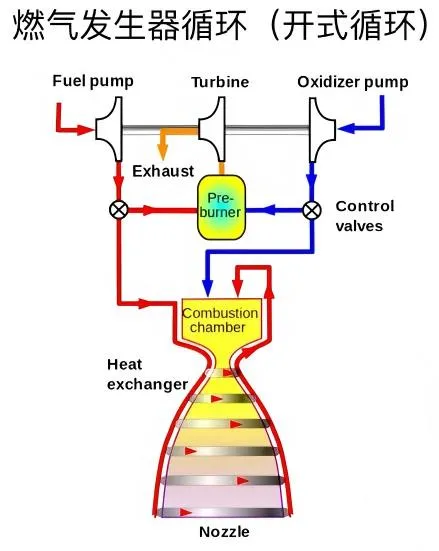
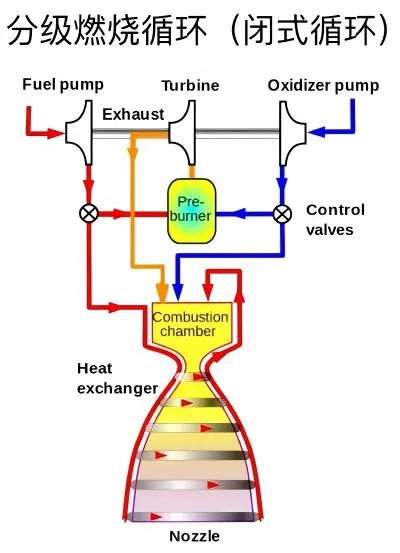
The staged combustion cycle, often referred to as the closed cycle, partially burns the propellant in a preburner first, and after the gas drives the turbine, the remaining gas is injected into the main combustion chamber, achieving nearly 100% propellant utilization. Its specific impulse is about 10-15% higher than that of the open cycle, and the combustion chamber pressure is more than doubled. Closed cycles are divided into two types: oxidizer-rich (liquid oxygen + hydrocarbon fuel) and fuel-rich (liquid oxygen-liquid hydrogen). International mature cases include Russia's RD-180, China's YF-100 series (oxidizer-rich), and the United States' RS-25 engine (fuel-rich). The closed cycle significantly improves specific impulse and performance, making it suitable for medium and large launch vehicles. However, the increased technical complexity raises development risks and costs, and it has become a representative of high-efficiency standards in modern aerospace. Among them, the oxidizer-rich cycle with liquid oxygen-kerosene/methane has become a key direction for international commercial development.
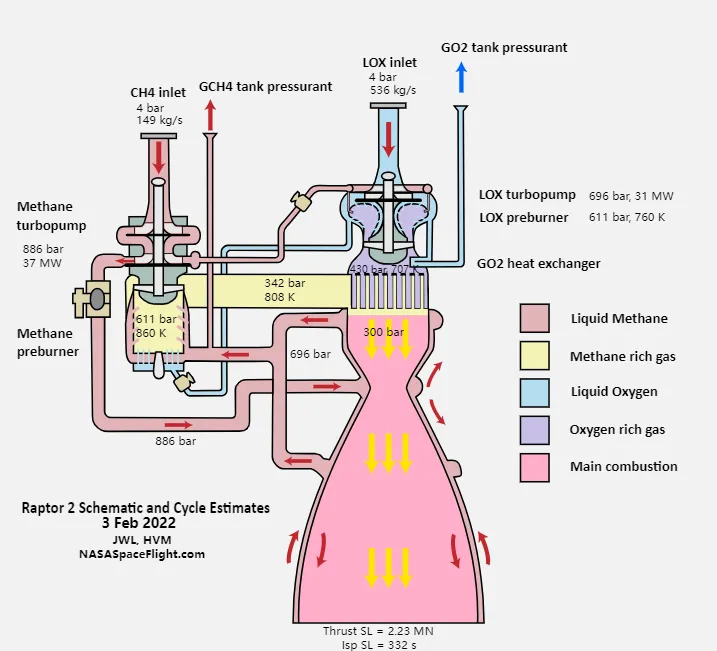
As the ultimate variant of the staged combustion cycle, the full-flow staged combustion cycle sends all fuel and oxidizer through separate preburners respectively to generate moderate gas that drives the turbine, and then all the gas enters the main combustion chamber. This "full-flow" design can achieve ultra-high combustion pressure with lower turbine temperatures, improving engine performance while ensuring service life and reusability, but the technical difficulty increases exponentially. Historically, the Soviet Union attempted to develop this technology in the 1970s but failed, and currently only SpaceX's Raptor engine has achieved engineering application worldwide. It represents the peak level of chemical propulsion, providing the highest efficiency and thrust, but its extreme complexity was once regarded as an engineering limit.
The technical difficulty of the closed cycle lies in the increased system complexity, which requires precise control of the combustion coordination between the preburner and the main combustion chamber, and places higher requirements on turbine materials and cooling systems. However, compared with the full-flow cycle, the staged combustion cycle has a lower technical threshold and is more likely to be the first to be broken through by commercial aerospace enterprises—advanced manufacturing technologies such as 3D printing can simplify the structure and reduce costs, and the accumulation of institutional technology spillover and team experience can shorten the R&D cycle. From the perspective of industrial rhythm, 2025-2030 will be a critical period for the industrialization of closed-cycle engines in China's commercial aerospace sector, and enterprises that take the lead in mass production will establish core competitive advantages. Therefore, the full-flow cycle is the long-term technical goal of commercial aerospace, while the closed cycle is the key focus of commercial aerospace in the current stage.
Industry Status Quo
SpaceX Leads the Era with Advanced Technology, and Domestic Closed-Cycle Engines Have Made Breakthroughs
In the global commercial aerospace power sector, SpaceX and domestic enterprises are in different stages of technological tackling. As of December 24, 2025, the company has completed more than 600 launches, including approximately 170 launches in 2025 alone. Its Starship, equipped with Raptor engines, has completed 11 test flights, achieving key missions such as suborbital flight, simulated satellite deployment, in-orbit ignition and sea-based soft landing. The development process of the Raptor reflects SpaceX's iterative philosophy: from Raptor 1 to Raptor 3, thrust has been increased, weight has been reduced, and manufacturing has been simplified. The current parameters of the Raptor are staggering—a combustion chamber pressure of 350 bar and a thrust of 280 tons. Overseas commercial aerospace companies have focused their research on oxidizer-rich cycles, and numerous oxidizer-rich liquid oxygen-kerosene/methane engines are under development, such as Germany's FRA Corporation's Hulix, the United States' Blue Origin's BE-4, Rocket Lab's Archimedes, Launcher's E-2, and Ursa Major's HADLEY.
The Sixth Academy of Aerospace Science and Technology Corporation is a professional research institute for liquid rocket engines in China's institutional sector, and is advancing the "Eight-Year Nine-Engine" plan. Typical mature products include:
YF-100: A liquid oxygen-kerosene engine with a ground thrust of 120 tons, adopting an oxidizer-rich staged combustion cycle (similar to Russia's RD-180). It is used on the Long March 5/6/7 rockets. It has high efficiency (a specific impulse of about 300 seconds), is not a full-flow design, has no exhaust gas loss, but the combustion chamber pressure is lower than 200 bar. In 2025, the YF-100 has been upgraded to the YF-100K to support heavy-lift launch vehicles.
YF-75D: A liquid hydrogen-liquid oxygen engine with a thrust of 8 tons, adopting an expander cycle. It is used on the upper stage of the Long March 3 rocket. It has extremely high efficiency (a specific impulse of 450 seconds), but has low thrust and is suitable for vacuum environments.
YF-77: A liquid hydrogen-liquid oxygen engine with a thrust of 70 tons, adopting a gas-generator cycle. It is used on the core stage of the Long March 5 rocket.
In terms of engines under development, the Sixth Academy is focusing on advanced cycle modes, with the most typical being the full-flow cycle YF-215. As of August 2025, it has completed the hot test assessment of the oxidizer-rich-fuel-rich combined semi-system. The original plan was to conduct a full-system test in October 2025, and there is no latest news so far. Optimistically, this model will fly with a rocket in 2030. Overall, the progress of the Sixth Academy's R&D projects is accelerating, with a record number of tests conducted in 2025.
In China's commercial aerospace sector, the development of oxidizer-rich cycle engines has been continuously explored, and gratifying breakthroughs have been achieved.
Core Investment Strategies for Commercial Aerospace Rocket Engines
From the perspective of industry development laws, the staged combustion cycle (closed cycle) has become an inevitable trend. Compared with the open cycle, the commercial value brought by its technical advantages is irreplaceable, making it the most certain investment track in the current stage.
The core advantages of the staged combustion cycle are reflected in three dimensions:
More Advanced Combustion Technology and Greater Thrust Potential
The staged combustion cycle generates gas in the preburner before it enters the main combustion chamber, forming a more stable gas-liquid mixed combustion with the propellant. In contrast, the open cycle uses direct liquid-liquid combustion of propellants, which is prone to combustion instability and has limited thrust improvement potential.
Higher Propellant Utilization Efficiency and Significant Specific Impulse Advantage
In the staged combustion cycle, the gas from the preburner drives the turbine to do work and then re-enters the main combustion chamber to participate in combustion, so all fuel can be converted into thrust. In the open cycle, this part of the gas is directly discharged, resulting in a 5%-10% waste of propellant. With the same propellant combination, the specific impulse of a staged combustion cycle engine can be 10%-15% higher than that of an open cycle engine.
Significantly Improved Payload Capacity to Match Core Market Demands
According to six-degree-of-freedom trajectory simulation results, medium and large launch vehicles equipped with staged combustion cycle engines can increase their low-Earth orbit payload capacity by more than 30%, with even more significant improvements in high-orbit payload capacity, which can accurately match the current market demand for large payloads such as low-orbit satellite constellation networking and deep-space exploration.
The core of commercial aerospace investment lies in "investing in technology, teams and rhythm". Combined with the current industry situation, the selection of investment targets must firmly grasp three core criteria:
Primary Criterion: The Core Team Must Have Successful Experience in Staged Combustion Engine Models
The core strength of domestic commercial aerospace enterprises mostly comes from aerospace experts who have left the institutional sector to start their own businesses. The R&D of staged combustion cycle technology relies heavily on long-term engineering accumulation rather than theoretical breakthroughs. Therefore, before investment, it is necessary to focus on verifying the background of the core team: whether they have deeply participated in the development of staged combustion cycle engine models (such as key links including preburner design, turbopump linkage, full-system testing and troubleshooting). Teams with successful experience in staged combustion engine models can not only avoid many detours in R&D, but also quickly integrate industry resources to promote engineering application.
Key Criterion: Gradual Technological Route, Resolutely Avoiding "Skipping Levels"
The technological evolution of rocket engines follows the objective law of "open cycle → staged combustion cycle → full-flow cycle". Although the full-flow cycle is the ultimate direction, its technical difficulty increases exponentially and requires a large number of test verifications. Even SpaceX, after a decade of efforts, is still in the stage of exploring engineering application. Some domestic enterprises have blindly laid out the full-flow cycle, which is a typical case of technical "level skipping". At the current stage, priority should be given to enterprises that "focus on the staged combustion cycle with a clear path": the first category is enterprises that have completed hot tests of staged combustion cycle engines and entered the industrialization preparation stage; the second category is enterprises that have smoothly transitioned from the open cycle to the staged combustion cycle with a clear technical upgrade timetable.
Auxiliary Criterion: Cost Control Capability
The ultimate goal of commercial aerospace is profitability, and investment targets must have a clear path for cost control. On the cost side, it is necessary to focus on whether advanced manufacturing technologies such as 3D printing are adopted, evaluate the enterprise's control over the supply chain of core components (such as turbopumps and valves), and ensure that commercialization can be achieved quickly after the technology is implemented.
In summary, we are in the dawn of a new era of commercial aerospace driven by technological revolution. SpaceX's Raptor engine has completely raised the industry's performance ceiling and competitive threshold.
For investors, the commercial aerospace rocket engine sector is full of opportunities but also fraught with technical traps. Successful investment requires us to not only understand the technical principles behind cutting-edge technologies such as the Raptor, but also to be down-to-earth and use the most rigorous commercial due diligence to examine the technical routes, business models and execution capabilities of each company.
Source: Lyu Kefei, Investment Department VI
Reviewer: Xue Yao
Publisher: You Yi


