


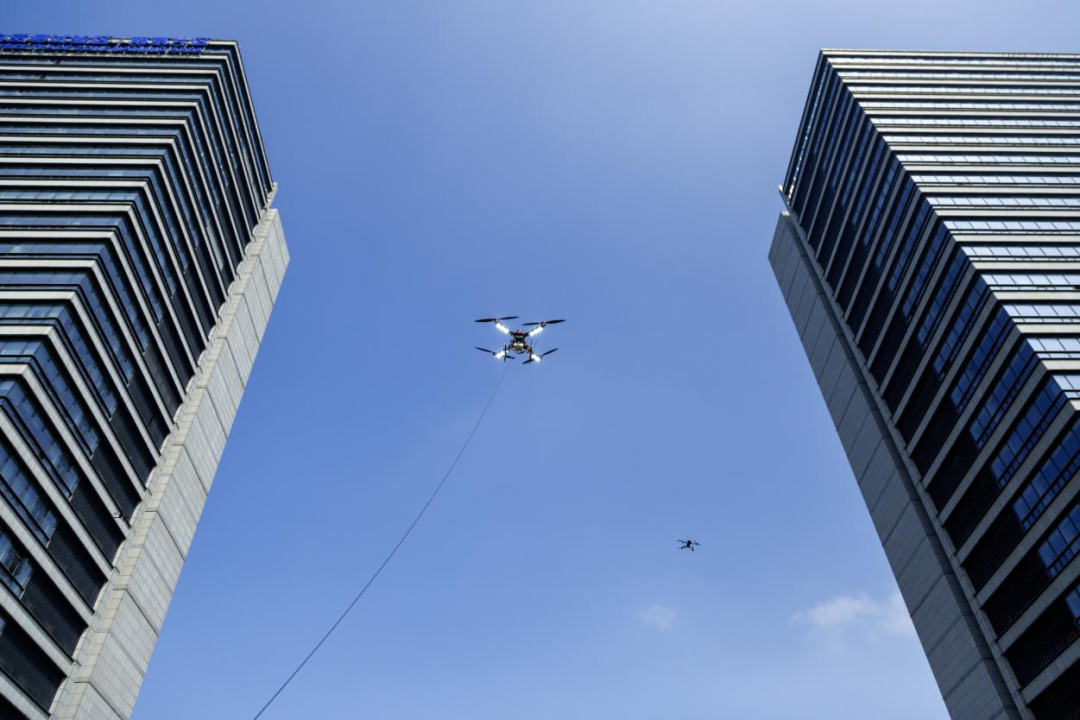
Building the "Wanda Plaza of the Low-Altitude Sector"
The first phase of Aokun Base covers an area of approximately 1,400 square meters, mainly consisting of an airborne system laboratory, a structural strength laboratory, a propulsion system laboratory, an aircraft noise laboratory, and other facilities. It is equipped with vertical take-off and landing (VTOL) sites, runways, and various comprehensive support facilities for helicopters, small fixed-wing aircraft, and drones to take off and land.
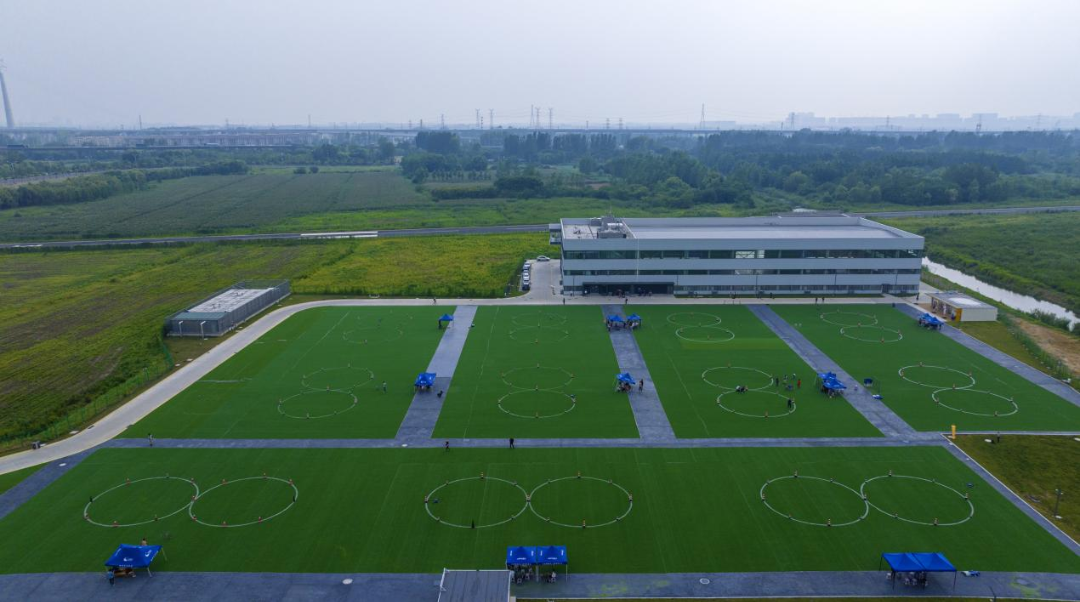
Looking Around, the Test Flight Base Has Taken Shape, with Technicians Moving Between Labs
“Our helicopter has just received a mission and has already flown to Changzhou!” A staff member said, pointing to the aircraft flying away.
Why would an enterprise spend a huge sum of money to purchase a helicopter on its own? Xiao Fei explained: “Verifying the design of aviation products in real flight has irreplaceable advantages that no ground laboratory can match. Take the testing of communication and navigation equipment as an example—sometimes, simulating the electromagnetic environment in a ground laboratory is costly and has limited effectiveness. However, mounting the equipment on a general-purpose aircraft for flight tests yields more authentic and reliable verification results, and is sometimes more economical.”
As he spoke, he painted such a picture: a helicopter flies over the glistening waters, capturing every fluctuation of electromagnetic interference in a real environment.
This innovative model directly addresses industry pain points. With the localization of large aircraft and the rapid development of general aviation, the demand for professional test flight services has surged. However, there are only a handful of professional institutions in China that can provide test flight services, resulting in a severe shortage in the market. Currently, Aokun Technology owns one self-purchased helicopter and one managed fixed-wing aircraft, providing customers with full-process, all-element “airborne laboratory” services, including test flight technical consulting, modification services, and test flight organization and implementation.
Recalling the Decision to Settle in Nanjing,When talking about the decision-making process of settling in Nanjing, Xiao Fei recalled that in early 2024, the company had the idea of building an aviation equipment test flight base. At that time, the team inspected multiple cities in the Yangtze River Delta but struggled to find an ideal site. “Traditional industrial zones are like jigsaw puzzles that can’t be put together—areas with factory buildings lack take-off and landing space, while places with open space can’t have factory buildings constructed.” The problem was finally solved when they encountered the Nanjing Low-Altitude Comprehensive Flight Base in Pukou High-Tech Zone.
“Here, there are both standardized factory buildings and open take-off and landing areas, and the land use type is a perfect match,” Xiao Fei said. What impressed him even more was the “Nanjing Speed” of Pukou High-Tech Zone—all procedures were completed in just three months, from the first negotiation to the official signing. The local government also provided supporting policies specifically for the base, such as airspace coordination and industrial chain connection, hitting the “accelerator button” for the project.
A Blueprint Beyond the Present.Currently, the base has undertaken test flight tasks for multiple projects, but Xiao Fei’s vision extends far beyond the present. He outlined an exciting blueprint: “Relying on this base, we will expand functions such as airworthiness certification, maintenance and modification, personnel training, and even popular science and research studies, to build an aviation industry ecosystem radiating across the Yangtze River Delta.” He made a vivid analogy: “Just as Wanda Plaza integrates diverse business formats, we want to be the ‘Wanda Plaza of the low-altitude sector’. The Nanjing base is the first piece in the puzzle; in the future, the company will connect dots into lines in the Pearl River Delta, Northwest China, Northeast China, and other regions, weaving an aviation engineering service network covering the whole country.”
The Rise of a Private Enterprise Amid the Take-off of the C919
Rewind to 2015: Xiao Fei, who was working at a well-known domestic enterprise at that time, registered Aokun Technology with an entrepreneurial dream, but had no clear direction for his business.
A turning point in fate came in 2017. “At that time, a domestic enterprise imported a light helicopter from Europe and needed to re-conduct airworthiness certification in China. I was invited to participate in this project, and this opportunity made me realize the huge potential here,” Xiao Fei said.
In fact, in the same year, China’s aviation industry achieved a milestone breakthrough. On May 5, 2017, amid the deafening roar of engines, the domestically produced large aircraft C919 successfully made its maiden flight at Shanghai Pudong International Airport. This feat shocked the entire aviation industry like spring thunder and also stirred up waves in Xiao Fei’s heart.
At that time, two major industrial waves were sweeping across China’s aviation sector: on the one hand, the state vigorously promoted the strategic layout of the localization of the large aircraft industrial chain, and the entire industry’s attention to civil aviation continued to rise; on the other hand, the low-altitude economy began to emerge, showing vigorous vitality. As a “passport” for civil aviation products and components to legally enter the market, the demand for airworthiness certification surged exponentially. However, at that time, the domestic aviation industry’s understanding of airworthiness certification was almost non-existent, and private enterprises specializing in airworthiness certification services were extremely rare.
The knock of opportunity became increasingly clear, and the entrepreneurial fire in Xiao Fei’s heart was completely ignited. He lost no time in “recruiting talents”—relying on his years of accumulated connections and reputation, he brought former colleagues who had fought side by side with him into the entrepreneurial team one by one. This “dream team” composed of industry veterans quickly made inroads in the market with their profound professional accumulation in the field of airworthiness certification.
Today, although the proportion of airworthiness certification business in the company’s overall business has dropped from the initial “dominant position” to 20%, its absolute scale continues to climb, and it has become an important “traffic entry point” for the company. “Customers come to us with certification needs, but as the project progresses in depth, we find that they also have needs in links such as design and development, testing and verification, so we can naturally extend more services,” Xiao Fei said.
For example, for a long time, in the field of complex systems such as airborne flight control, avionics, electromechanics, and power, China’s aviation industry has lacked professional general simulation test platforms, flight test platforms, and professional tool software, resulting in a large gap compared with advanced international standards. Faced with this dilemma, many enterprises have had to spend huge sums of money to introduce foreign solutions, while also facing the risk of “choking points” due to technological blockades at all times. To this end, Aokun Technology resolutely opened a “second battlefield” in 2021, starting the independent R&D of the AeroKMatrix series of aviation measurement and control products, and providing customers with customized test platform solutions that run through the entire product development life cycle, including requirement development and confirmation, system integration and verification, automated testing, and flight testing. The products have already played an important role in multiple model development projects.
After years of in-depth development, Aokun Technology has built an impressive industry landscape: it has served more than 100 high-quality customers in the aviation field and deeply participated in over 200 model development and certification projects. In the large aircraft track, Aokun Technology is a technical partner of “national team” enterprises such as COMAC (Commercial Aircraft Corporation of China), AVIC (Aviation Industry Corporation of China), AECC (Aero Engine Corporation of China), and CETC (China Electronics Technology Group Corporation); in the booming low-altitude economy field, the company has provided various engineering and technical services to many leading domestic eVTOL (electric Vertical Take-Off and Landing) enterprises and supporting manufacturers, including EHang, XPeng XHT, Volant, Lanyi, E-Vtol, and Muyu Tian.
A “Scarce Shovel Seller” in the Aviation Industry
“Shovel seller”—this is how Xiao Fei positions Aokun Technology. “Amid the current ‘gold rush’ boom of China’s aviation industry development, Aokun is a company that ‘sells shovels’. We are willing to provide the entire industry with various professional engineering services and solutions that can solve practical problems,” he said.
In the booming civil aviation field, professional engineering service providers are as rare as morning stars. A relevant person in charge of the Future Angel Investment Department of Nanjing Venture Capital Group admitted: “We have contacted many technology providers and manufacturers in the aviation field, but targets like Aokun with professional service capabilities are quite scarce. The company not only has a first-mover advantage but also has assembled a top-tier technical team in the industry; more importantly, it has already formed a considerable business scale.”
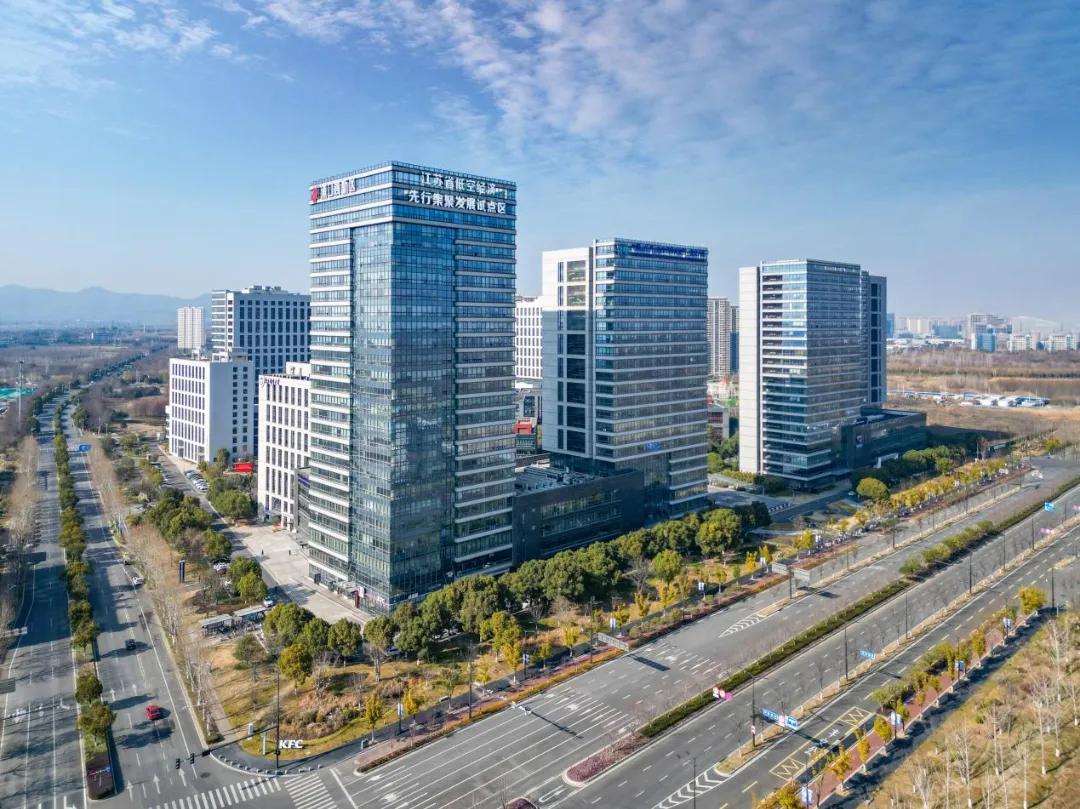
Source: Venture Capital Group
Review: Xue Yao
Release: You Yi


