


According to the "2024 China Game Industry Report" released by the Game Publishing Committee of the China Audio-Video and Digital Publishing Association, the domestic game market achieved actual sales revenue of 325.783 billion yuan in 2024, a year-on-year increase of 7.53%, setting a new historical record. Entering 2025, institutions generally anticipate that due to policy support encouraging cultural and entertainment consumption, the growth momentum of the game industry remains strong.
Amid this booming industry wave, a group of young people from all over the country chose to gather in Nanjing to cultivate a "niche and rugged" track—rhythm games. Over five years, they tapped out the rhythms of youth with keyboards, built fantastical worlds with code, and continuously strived to break through the commercialization bottlenecks of rhythm games under limited resources, carving out a unique space for value narrative.
Geek Assembly: "Striking the Chord" of Entrepreneurship in Nanjing
In the summer of 2020, Mei Siyuan, fresh out of university, gathered a special team. These young people hailed from Quzhou in Zhejiang, Yulin in Shaanxi, Xiamen in Fujian, Chaoshan in Guangdong, and other places, with diverse professional backgrounds but sharing the same identity—rhythm game "geeks." In the once-popular arcade rhythm game "Maimai," they each scored around 16,000 points, earning the "rainbow frame" symbolizing the highest level.
"Rhythm games don’t require complex social skills, yet they allow deep resonance with music, serving as a life seasoning for introverts." As early as middle school, Mei Siyuan was deeply captivated by the bouncing notes in arcades. With the rise of smartphones, arcade rhythm games gradually declined, but the melodies that carried the youthful memories of countless players still guided everyone to seek new possibilities for rhythm games.
During university, Mei Siyuan met like-minded rhythm game enthusiasts, and the player community became his "creative lab." At the time, everyone was obsessed with the mobile rhythm game "Dynamix." Many players were passionate about "secondary creation," such as using editors to make custom levels and incorporating their favorite music into the game.
The software engineering student had a sudden inspiration: he developed a visual editor that significantly simplified the process of creating custom levels, enhancing the player experience. This tool quickly gained popularity in the player community and planted the seed of rhythm game entrepreneurship in Mei Siyuan’s mind.
Starting in 2019, Mei Siyuan began a "two-front battle": interning at a game company in Xiamen during the day to gain experience, and refining his own rhythm game project at night. After considering factors such as talent resources, industrial environment, and policy support, he ultimately chose Nanjing as a key "base" for his entrepreneurial journey—a city blending cultural heritage with innovative vitality, perfectly matching the team’s vision of a "livable and workable" environment.
In September 2020, Nanjing Jixian Network Technology Co., Ltd. (hereinafter referred to as "Jixian Network") was officially established. "Create a mobile rhythm game that rivals the arcade experience!" With this dream, a group of young people began to "strike the chord" of their entrepreneurial journey on the "strings" of the rhythm game industry.
"Paradigm" Innovation: Making Notes "Dance" in Three-Dimensional Space
On February 9, 2024, the domestic version of "Paradigm: Origin" was officially launched, and Mei Siyuan’s five-year rhythm game project finally became a reality. "This is not just a game; it carries our youth, passion, and perseverance," he said.
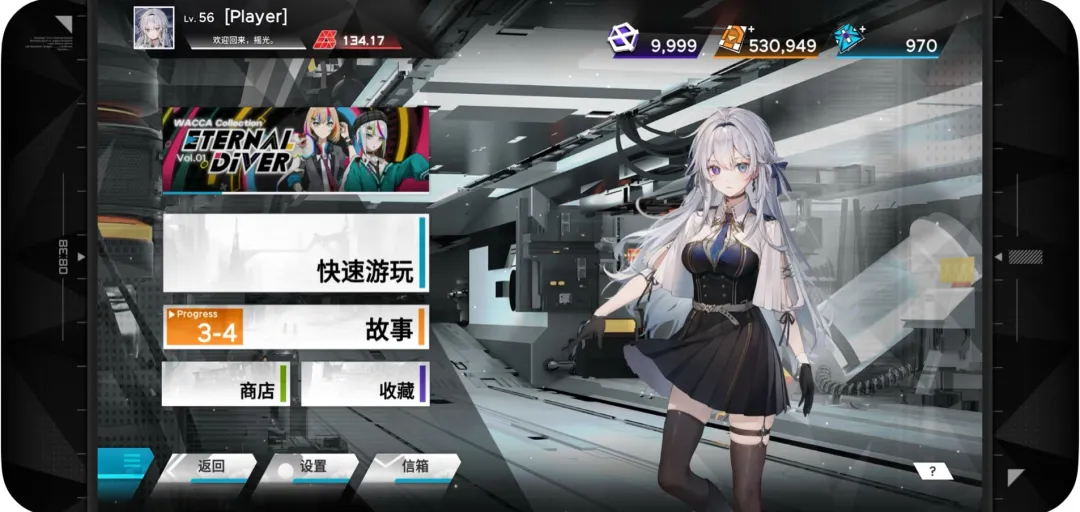
Mei Siyuan clearly remembers December 25, 2023, when Paradigm: Origin appeared on the list of approved version numbers for domestic online games. "This was simply the best Christmas gift!" he exclaimed, unable to contain his excitement.
Since starting the business, Jixian Network has raised a total of 2.9 million yuan in funding, but the project burned through money far faster than expected. "At one point, we were completely strapped for cash—after paying the team's salaries, the company account was basically empty." The successful approval of Paradigm: Origin’s domestic version number undoubtedly gave the team a glimmer of hope after a long wait.
The production team’s high expectations for Paradigm: Origin also stem from their unwavering commitment to the game’s core gameplay, music content, and visual presentation, always adhering to the philosophy of "striving for the best quality within a limited budget, no matter how tough it gets."
According to reports, Paradigm: Origin builds on traditional arcade rhythm games and modern mobile rhythm games, incorporating both inherited and innovative design concepts. The game abandons the traditional 2D gameplay, expanding the operational field into a three-dimensional space. When notes fly in from all directions—up, down, left, and right—the game creates a intense three-dimensional impact, while maintaining a logic that can be mastered with just two fingers, catering to both hardcore and casual players.
Additionally, the game’s music library emphasizes "quantity and quality," featuring over 200 high-quality tracks, including numerous exclusives. It is worth mentioning that the team successfully invited top overseas composers "xi" and "Sakujo" to collaborate on tracks—artists who had previously worked mostly with major industry players. The difficulty of securing both "rhythm game legends" simultaneously was imaginable.
"Sincerity is the ultimate weapon," Mei Siyuan recalled. Overcoming language barriers, the production team accurately conveyed the game’s message and design philosophy, while also assuring the composers, "Feel free to express your creativity—we will fully support you." As it turned out, this track not only became a brilliant highlight of Paradigm: Origin but also caused a sensation in the rhythm game community, hailed by players as the "hidden final boss."
At the end of 2024, Jixian Network hosted a Paradigm: Origin tournament in Shenzhen. As the game’s three-dimensional interface lit up the big screen, notes surged from all directions, and an "epic" track filled the air, the live players erupted into thunderous cheers. In that moment, Mei Siyuan felt a surge of emotion: "All our efforts have been rewarded."
Long-Term Breakthrough: Defining the Future of Rhythm Games with Passion
As of April this year, the domestic version of Paradigm: Origin has been operating steadily for 14 months, with cumulative revenue exceeding 3 million RMB, over 1 million registered users, and monthly active players in the range of 100,000. For a niche genre like rhythm games, such market performance is no small achievement.
"The rhythm game industry is not destined to be a highly profitable business; we aim for a sustainable, long-term model," Mei Siyuan admitted. The monetization strategy for rhythm games relies on "content pay-for-content." Even if players purchase all over 200 tracks in Paradigm: Origin, the total cost remains under 1,000 RMB, with each track averaging just a few yuan.
However, unlike most games with high player turnover, rhythm games often attract a dedicated base of "hardcore players" who exhibit remarkable loyalty. Once players become attached to a game, not only does user retention remain high, but they also spontaneously form community-driven传播效应 (word-of-mouth effects), steadily expanding the user base. This means that once a startup team passes a critical development threshold, it can achieve sustained and resilient growth—provided the game's quality withstands the test of both market and time.
Wearing thick gloves in the scorching summer, thin short sleeves in the bitter winter, carrying heavy water bottles on their shoulders, and tirelessly tapping away at an eight-key "washing machine" testing station—the Paradigm: Origin development team has tried almost every rhythm game on the market to deepen their understanding and pursue the ultimate player experience. When asked why they are so "meticulous," Mei Siyuan’s answer was simple: "Because we ourselves are the most demanding players."
It is reported that Jixian Network has been selected for the "Nanjing Outstanding Youth College Student Entrepreneurship Project" and will receive special funding support from the Nanjing Innovation Investment Group. The Future Angel Investment Department of the Innovation Investment Group stated that the game industry chain encompasses three major segments: R&D, publishing, and platforms. Although Nanjing boasts R&D capabilities and talent reserves comparable to first-tier cities, it lacks leading enterprises that can drive resource integration and amplify industry influence. Currently, Jixian Network’s rhythm game has gathered a substantial user base, and the team continues to refine the product with a philosophy of "refining, detailing, and strengthening," gradually evolving from a pure game developer to a comprehensive enterprise integrating both R&D and publishing.
With the financial support from the Nanjing Innovation Investment Group, Jixian Network will focus on addressing its cash flow shortages and strengthening weak areas such as product promotion and channel development. "Though still a budding seed, it already shows the potential to grow into a towering tree," the Future Angel Investment team remarked.
Under the spotlight at the aforementioned rhythm game tournament, Mei Siyuan stood at the center of the stage, gazing passionately at the hundreds of players in the audience: "We want to develop Paradigm: Origin for a lifetime. Are you willing to play Paradigm: Origin for a lifetime?"
Waves of "Yes!" echoed through the venue. This was not just a collective vow between developers and players for a rhythm game but an eternal resonance of pure passion.
Source: Innovation Investment Group
Reviewed by: Xue Yao
Published by: You Yi


