


For further insights and opinions on this article, please contact the author:Luo Yanxi, Industrial Research Center, Nanjing Innovation Investment GroupEmail: luoyx@njicg.com
Aerospace, as a future-oriented industry, is one of Nanjing’s six strategic emerging industries. The city’s aerospace sector is now home to well-known enterprises including CETC 14th Research Institute, CETC LES, and Chenguang Group.
At the recent 2026 World Economic Forum in Davos, Elon Musk announced that SpaceX would partner with Tesla to build 200 GW of solar manufacturing capacity per year, mainly to power space AI satellites and ground data centers, with the goal of deploying the first 100 GW space-based photovoltaic system by 2030.
First proposed as a scientific concept in the 1960s, space-based photovoltaics (SBSP/SBPV) has recently returned to public attention and gained extraordinary traction due to Musk’s promotion.
01 What Is Space-Based Photovoltaics?
Space-Based Photovoltaics (SBPV), also known as Space-Based Solar Power (SBSP), is a technical system that deploys photovoltaic modules in space to convert solar energy into electricity. The power can directly supply spacecraft or be transmitted to the ground power grid via wireless means (microwave / laser).
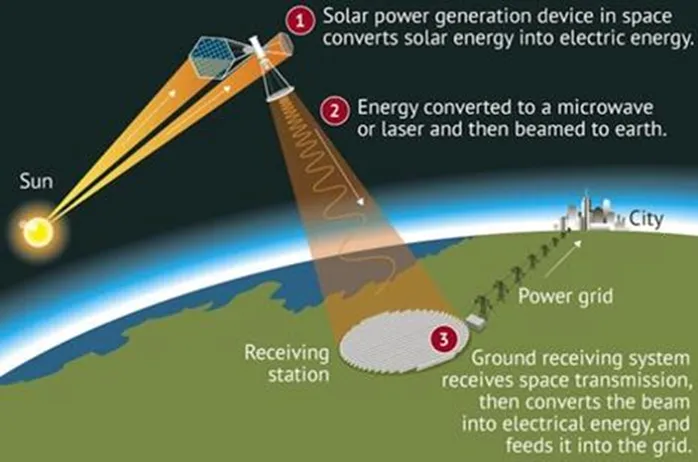
Its core value lies in leveraging space’s unique advantages:no atmospheric obstruction, 24‑hour solar irradiation, and higher energy intensity.It breaks through the limitations of ground-based solar power and provides a new solution for energy transition and the space economy.
02 Development History of Space-Based Solar Power
In 1958, the U.S. Pioneer satellite successfully used on-orbit photovoltaic cells for the first time. Although the photoelectric conversion efficiency was only 6%, it provided far more durable on-orbit power than chemical batteries and proved technical feasibility.
In 1968, Dr. Peter Glaser formally proposed building a space solar power station and transmitting electricity to Earth via microwaves, but implementation was limited by low technological maturity.
From the 1970s onward, gallium arsenide (GaAs) cells gradually replaced silicon-based cells, offering higher efficiency and stronger radiation resistance. Meanwhile, wireless power transmission entered a long period of research and development.
In 2023, Caltech’s Space Solar Power Demonstrator satellite successfully verified the MAPLE microwave wireless power transmission system in orbit, realizing space-to-space short‑distance power transfer for the first time.
Laser power transmission has also emerged as a promising alternative, especially for long‑distance transmission.
In summary:
Short term: SBSP will focus on powering satellites, space stations and other spacecraft.
Medium term: It will support low‑orbit satellite constellations and the “space computing power network”.
Long term: After technological maturity, it will become the energy foundation of space‑based networks and gradually enable large‑scale power transmission to Earth.
03 Drivers and Constraints of the SBSP Industry
(1) Driving Factors
PolicyCommercial aerospace is listed as a strategic emerging industry in China.Advanced PV technologies such as perovskite are strongly supported.SBSP is regarded as a strategic tool and a potential ultimate energy solution for humanity.
TechnologyBreakthroughs in reusable rockets, new photovoltaic cells, and wireless transmission have created conditions for large‑scale commercialization.
MarketSpace features nearly constant sunlight (especially in geostationary orbit),solar irradiance more than 30% higher than on the ground,and proximity to space‑based networks,giving SBSP stronger market potential than ground PV.
(2) Constraints
Extremely high launch and deployment costsCurrent launch costs lead to SBSP electricity prices of $2–3/kWh,dozens to hundreds of times higher than ground PV.
Low wireless energy transmission efficiencyOverall system efficiency is estimated at only 10%–15%,with large losses in conversion and transmission.
Complex engineering and governance challengesConstruction and maintenance of giant on‑orbit structures,long‑term stable operation in extreme environments,competition for orbital and spectrum resources,precise beam control,and safety and ecological impacts all pose major hurdles.
04 Why Is Musk Championing Space-Based Solar Power?
At the 2026 Davos Forum, Musk revealed that SpaceX and Tesla will build 200 GW of PV capacity, including 100 GW in space.
This is not merely an energy project, but an integrated space‑based ecosystem:PV + satellites + computing power + energy storage.Its core goal is to solve the energy bottleneck for the AI computing boom, space exploration, and interplanetary colonization.
In the author’s view:Musk is promoting SBSP now to market the Starship and complete his commercial ecosystem loop.
After the success of Falcon 9, Musk launched Starlink to absorb launch capacity and expand to C‑end users, forming a closed loop:
reusable rockets → large low‑orbit communication constellations → global consumers.
Starship, the next‑generation rocket, aims to reduce launch cost from $3,000/kg to $100/kg and enable hourly launches.
Such massive launch capacity requires massive new demand.
A 100 GW SBSP system would require 100,000 to 1.67 million satellites —far more than the ~15,000 satellites launched in human history.This would provide sustained, massive launch demand for Starship.
Ultimately, Musk’s vision is to build a space‑based ecosystem that supports humanity becoming a multiplanetary species.SBSP is only one piece of this larger blueprint, not an end in itself.
05 Investment Opportunities in Space-Based Photovoltaics
Although SBSP is still in an early embryonic stage with high uncertainty, huge costs, and long payback periods,its strategic importance makes it worthy of long‑term attention.
Structural investment opportunities include:
(1) Rockets & Launch
Reusable rockets will continue to evolve toward heavier payload, full recovery, and airline‑style operation.
Opportunities in secondary recovery, large core components, and rocket servo systems.
(2) Wireless Energy Transmission
Laser transmission: immature but fast‑growing, suitable for space‑to‑space transmission.
Microwave transmission: more mature, better atmospheric penetration, more suitable for space‑to‑ground transmission.
(3) Photovoltaic Cells
Short term: triple‑junction / quadruple‑junction GaAs cells dominate for high‑value satellites.
Medium term: P‑type HJT cells with better radiation resistance and light weight.
Long term: perovskite tandem cells with high specific power and lightweight advantages.
Investment Strategy
For such a frontier, concept‑heavy track:Stay informed, act cautiously; think long-term, act gradually; focus on structural opportunities.
SBSP faces great challenges and uncertainties,yet it is likely to become a critical pillar of the future space ecosystemand a strong complement to terrestrial energy.
Source: Luo Yanxi, Industrial Research Center
Reviewed by: Xue Yao
Released by: You Yi


