


If you have further insights and thoughts on this article, you may contact the author: Han Jiakang, Compliance Management Department, Nanjing Innovation Investment GroupE-mail: hanjk@njicg.com
In the new economic environment driven by technological innovation for industrial development, intellectual property has become the core competitiveness of numerous enterprises. Especially for start-ups in the stage of rapid growth, they often face patent challenges initiated by third parties in the process of technological R&D and market expansion. Improper handling of a patent infringement lawsuit may not only have a negative impact on an enterprise's financial operations, but also severely damage its technological layout, core competitiveness and market reputation. Therefore, a systematic understanding of the core logic and practical key points of patent infringement defenses is of great significance for enterprises to effectively respond to infringement allegations and safeguard their legitimate rights and interests. Taking patent infringement disputes as the entry point, this article systematically sorts out the common defense paths in judicial practice, and provides enterprises with references that combine legal basis and practical value.
Generally speaking, patent infringement defenses can be divided into two major categories: "non-infringement defenses" and "defenses for acts not deemed as infringement", as well as the patent invalidation declaration strategy that challenges the source of the right basis. Among them, the core of non-infringement defenses is that the alleged infringing act itself does not meet the constitutive elements of patent infringement, i.e., it does not constitute infringement in essence and there is no infringing fact. The core of defenses for acts not deemed as infringement is that the alleged infringing act has fallen within the scope of patent protection, i.e., it has met the constitutive elements of infringement and should have constituted infringement, but due to statutory reasons, the law stipulates that such act is "not deemed as infringement" or "shall not bear compensation liability". The following will specifically sort out several types of common defense reasons in combination with legal basis and practical key points.
01 Non-Infringement Defenses
(I) Prior Art/Prior Design Defense
Article 67 of the Patent Law (2020 Amendment) stipulates that in a patent infringement dispute, if the alleged infringer has evidence to prove that the technology or design it implements belongs to prior art or prior design, it shall not constitute an infringement of the patent right. From the perspective of legislative purpose, the reason why prior art/prior design is regarded as a defense reason is that the premise of obtaining patent protection is that the relevant invention/design must have novelty. Prior art/design refers to the technology or design that has been known to the public at home and abroad before the filing date of the patent. As an alleged patent infringer, it is necessary to adduce evidence to prove that the technology or design it implements is identical or substantially identical to the features of the prior art or design, and that the product has been disclosed to the public through patent documents, journals, actual use or other means before the patent filing date. Taking the case (2023) ZuiGaoFa ZhiMin Zhong No. 869 as an example, during the trial, the Supreme People's Court found that although the relevant products produced and sold by the alleged infringer had not obtained patent authorization, they had been publicly listed and sold in the UK long before the filing date of the involved patent, resulting in the loss of novelty of the involved patent. The right holder of the involved patent, while knowing that the relevant structure belonged to the prior design, still maliciously applied for the patent and initiated the relevant patent infringement lawsuit, and therefore should also compensate the alleged infringer for losses such as fund occupation losses and commercial opportunity losses caused by its malicious litigation.
However, it should also be noted that although the court emphasizes examining whether the prior art/design has been disclosed before the patent filing date when deciding whether to support the prior art/design defense, not all actually disclosed facts can be used as the basis for the prior art/design defense. The basic facts for claiming the prior art/design defense also need to have legality. In a guiding case included in the database, the plaintiff owned a utility model patent for a certain handle, but the defendant had engaged in public acts such as producing such products and delivering them for transportation before the filing date. Based on this, the Suzhou Intermediate People's Court held that the prior art defense claimed by the defendant was established. However, in the case (2020) ZuiGaoFa ZhiMin Zhong No. 1568, the Supreme People's Court found after investigation that the prior art and public acts claimed by the defendant were generated by violating the confidentiality obligation under the agreement with the patentee, i.e., they had violated the agreement and the basic principles of civil law, and thus did not support the prior art defense claim put forward by the alleged infringer based on the fact state of illegal disclosure.
(II) Defense of Not Falling Within the Protection Scope
Article 7 of the Supreme People's Court's Interpretation on Several Issues Concerning the Application of Law in the Trial of Patent Infringement Dispute Cases stipulates that when a people's court determines whether an alleged infringing technical solution falls within the protection scope of a patent right, it shall examine all the technical features recorded in the claim asserted by the right holder. If the alleged infringing technical solution contains technical features that are identical or equivalent to all the technical features recorded in the claim, the people's court shall determine that it falls within the protection scope of the patent right; if the technical features of the alleged infringing technical solution are missing one or more technical features recorded in the claim, or have one or more technical features that are neither identical nor equivalent compared with all the technical features recorded in the claim, the people's court shall determine that it does not fall within the protection scope of the patent right. This judicial interpretation of the Supreme People's Court clarifies the core principle for patent infringement determination, namely the "doctrine of complete coverage". Therefore, in patent infringement defenses, it is also possible to reverse the argument by claiming that the alleged technology/design does not fall within the protection scope of the patent claims, for example, by demonstrating that the technical features, designs, etc. of the alleged infringing product are different or non-equivalent from those of the involved patent. As a technical defense method, it is necessary to focus on conducting a technical comparison between the product technical features or design features of the alleged infringing product and the patent claims, drawings and the applicable doctrine of equivalents of the right basis asserted by the plaintiff, so as to judge whether it complies with the "doctrine of complete coverage" for infringement determination.
(III) Statutory Non-Infringement Defense
Statutory non-infringement defense corresponds to the five types of non-infringement scenarios preset in Article 75 of the Patent Law. Its core logic is that although the alleged infringing act involves a patented product or technology, it directly excludes the determination of infringement in terms of the nature of the act because it conforms to the specific circumstances preset by law, i.e., the act itself does not meet the constitutive elements of patent infringement from the very beginning. Such defense reasons have clear legislative guidance and provide a clear basis for exemption for the acts of market entities within the scope of legal operation. The specific application rules can be further clarified through the following table.
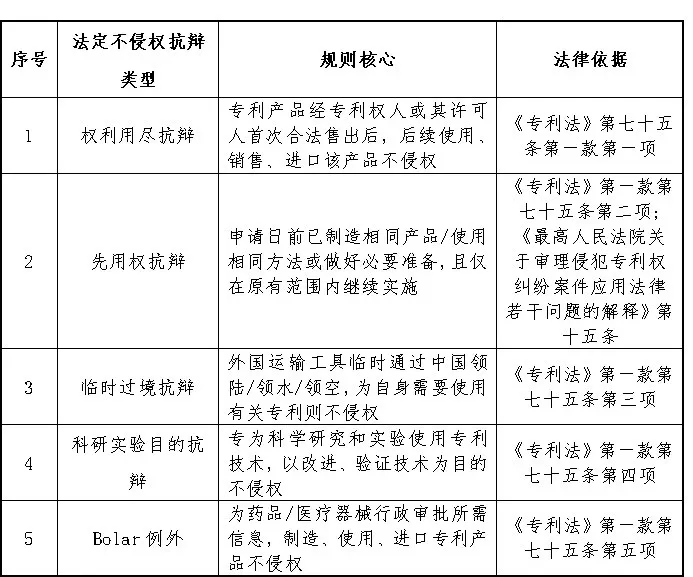
02 Defenses for Acts Not Deemed as Infringement
(I) Legitimate Source Defense
Article 77 of the Patent Law (2020 Amendment) stipulates that anyone who uses, offers to sell or sells a patent-infringing product that he does not know was manufactured and sold without the permission of the patentee for the purpose of production and business operation, and can prove the legitimate source of the product, shall not bear compensation liability. It should be noted that the prerequisite for the application of the legitimate source defense is that the alleged act has fallen within the scope of patent protection and constitutes infringement. However, based on the concept of maintaining the normal market operation order and encouraging the crackdown on the source of infringement, the legislation provides a conditional exemption space for the sales acts of sellers who have no subjective malice, but the legitimate source rule does not apply to the production acts that themselves fall within the protection scope of the involved patent. From the perspective of judicial practice, the legitimate source defense needs to meet two establishment elements at the same time: first, the user or seller of the infringing product has subjective good faith, i.e., he does not implement the relevant sales act on the premise of knowing that his product is infringing; second, the infringing product has a legitimate source.
In judicial practice, the court's examination of the transaction materials for legitimate source is often the core of whether the defense is established. Paragraph 3 of Article 25 of the Supreme People's Court's Interpretation (II) on Several Issues Concerning the Application of Law in the Trial of Patent Infringement Dispute Cases (2020 Amendment) stipulates that the "legitimate source" referred to in Paragraph 1 of this Article means obtaining the product through legal sales channels, ordinary sales contracts and other normal commercial methods. For the legitimate source, the user, offeror for sale or seller shall provide relevant evidence in line with transaction practices. At the same time, legitimate source does not require the product to originate from the patentee or the patent licensee, but means purchasing the alleged infringing product through legal channels. For example, providing legal delivery notes, transfer documents, relevant chat records of the alleged infringing product are all evidence to corroborate the legitimate source. In addition, although there is often no clear and unified standard for the element of subjective good faith, the court usually also conducts a certain examination of the subjective reasonable attention. For example, in the case (2025) ZuiGaoFa ZhiMin Zhong No. 68, the Supreme People's Court held that the seller has a duty of reasonable attention to the products sold, and should obtain the products through legal purchase channels, reasonable prices and qualified market entities. Since the alleged infringing product sold by the seller was a "three-no product" (no manufacturer, no production date, no quality certificate), it was difficult to determine that it was subjectively in good faith and without fault, and the legitimate source defense could not be established.
(II) Defense of Non-Production and Business Purpose
Article 11 of the Patent Law stipulates that after the grant of a patent right for an invention or utility model, unless otherwise provided in this Law, no unit or individual may exploit the patent without the permission of the patentee, i.e., no unit or individual may, for the purpose of production and business operation, manufacture, use, offer to sell, sell or import the patented product, or use the patented method, as well as use, offer to sell, sell or import the product directly obtained by the patented method. In other words, the infringing act must be "for the purpose of production and business operation"; if it is for a non-production and business purpose, it shall not be evaluated as infringement.
However, there is still no unified standard in judicial practice regarding the determination of what constitutes "for the purpose of production and business operation". In the case (2023) ZuiGaoFa ZhiMin Zhong No. 1747, the first and second instance courts once had a dispute over whether the embedding of public service modules such as Su* Code in the "Wo De* Jing" APP should be deemed as infringement. The first instance court held that Su* Code was for the purpose of public administration and did not constitute infringement because of its "non-production and business purpose". However, the Supreme People's Court held that although Su* Code had certain public service and public welfare attributes and was not directly for the purpose of production and business operation, the access traffic of the basic services brought market benefits and formed a diversified profit model, which met the element of "for the purpose of production and business operation", and thus ultimately determined that infringement was constituted. It can be seen that in the determination of the element of "non-production and business purpose", in some cases, in addition to examining whether the act itself has public attributes, the court also takes into account factors such as whether profits are generated and whether it may affect the market interests that operators in the same market may obtain.
(III) Compulsory License Defense
Compulsory license defense means that the relevant use of the involved patent has obtained a national compulsory license due to various statutory reasons, and if it is implemented within the scope of the license, no infringement liability shall be borne. The legal basis for the compulsory license defense is mainly reflected in Articles 53 to 58 of China's Patent Law (2020 Amendment).
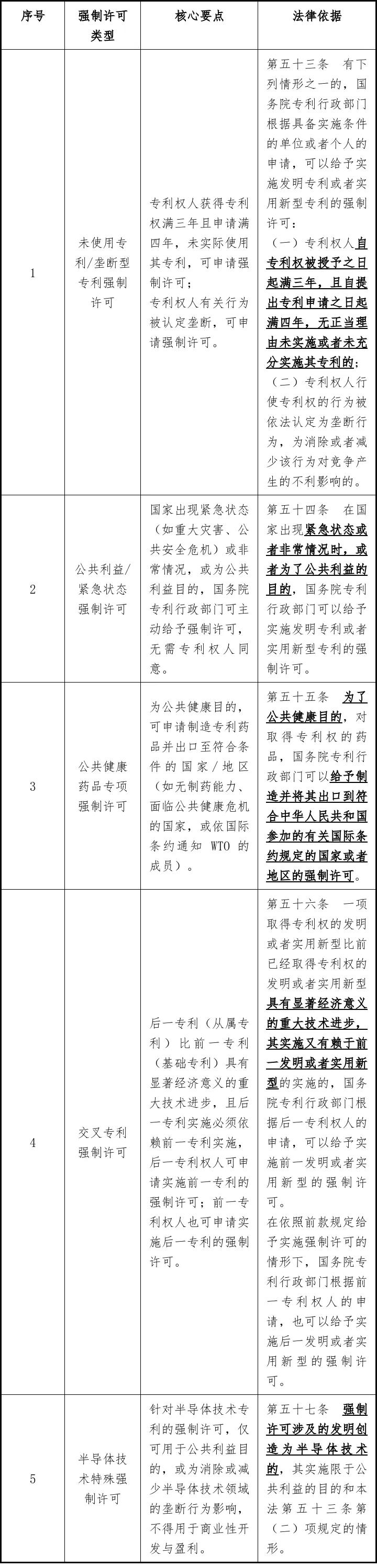
It should be noted that, except for compulsory licenses for public interests/emergency situations, all other types of compulsory licenses need to be actively applied for by the parties to the patent administrative department of the State Council, and can only be approved after the application is examined and meets the conditions. At the same time, the subject that obtains the compulsory license for implementation shall also pay a reasonable royalty to the patentee, the amount of which shall be negotiated by both parties; if the negotiation fails, it shall be ruled by the patent administrative department of the State Council.
03 Other Types of Defense Reasons
(I) Patent Invalidation Defense
Patent invalidation defense starts with the right basis of the plaintiff (usually the right holder) to find relevant reasons that do not meet the patent grant conditions under the Patent Law, such as lack of novelty, inventiveness, practicality, unclear claims, etc., by filing an invalidation declaration request with the National Intellectual Property Administration. If the patent is ultimately declared invalid, the plaintiff's infringement allegation will lose its right basis. Article 45 of the Patent Law stipulates that starting from the date on which the patent administrative department of the State Council announces the grant of the patent right, any unit or individual that believes that the grant of the patent right does not comply with the provisions of this Law may request the patent administrative department of the State Council to declare the patent right invalid. In practice, one of the most common reasons for invalidation declaration is the inventiveness stipulated in Paragraph 3 of Article 22 of the Patent Law. Inventiveness requires that compared with the prior art, the invention has prominent substantive features and remarkable progress, or the utility model has substantive features and progress. But what constitutes "prominent substantive features" and "remarkable progress"? The determination of this point by the National Intellectual Property Administration needs to combine the relevant patent documents submitted by the petitioner for invalidation declaration or prior art cases to split and compare the claims of the involved patent, so as to judge whether the claims have substantially distinct features compared with the prior art. Taking a case handled by the author as an example, the National Intellectual Property Administration held that even if there are distinct features between the technical solution claimed by the claims of the involved patent and the closest prior art, if the distinct features have been disclosed by other prior art or belong to the common general knowledge in the technical field, a person skilled in the art can obviously obtain the technical solution claimed by the claims based on the combination of the prior art, and the combination has not achieved an unexpected technical effect, then the claims also lack inventiveness.
If in the relevant infringement lawsuit (hereinafter referred to as the "principal lawsuit"), the court has rendered a judgment finding that patent infringement is constituted, and then the relevant patent reexamination institution of the National Intellectual Property Administration declares the patent on which the principal lawsuit is based invalid. At this time, whether the invalidation declaration can retroactively affect the original judgment depends on the status of whether the judgment has been executed or performed. Article 47 of the Patent Law stipulates that a patent right declared invalid shall be deemed to have never existed from the beginning. A decision to declare a patent right invalid shall not have retroactive effect on the judgments and mediation statements on patent infringement that have been made and executed by the people's court, and the decisions on the handling of patent infringement disputes that have been performed or compulsorily executed before the patent right is declared invalid. That means, if the court has made a judgment finding infringement in the principal lawsuit and the alleged infringer has also performed in accordance with the judgment, even if the National Intellectual Property Administration later declares the involved patent in the principal lawsuit invalid, it cannot affect the result of the principal lawsuit judgment. However, for those that have not been performed or executed, even after the principal lawsuit judgment takes effect, remedies can be sought in a timely manner through retrial and other channels. For example, in the case (2025) ZuiGaoFa Min Zai No. 307, the Supreme People's Court ruled to revoke the second instance judgment on the grounds that the second instance judgment had not been executed after it was made and the involved patent right had been declared totally invalid, and the decision had retroactive effect on the retrial of this case.
In the relevant infringement lawsuit, if the trial progress of the principal lawsuit is tight, the alleged infringer may, after filing an invalidation declaration request with the Patent Reexamination and Evaluation Department of the former National Intellectual Property Administration, file an application for suspension of the trial with the principal lawsuit court by virtue of documents such as the patent right evaluation report and trial notice fed back by the National Intellectual Property Administration. Paragraph 1 of Article 153 of the Civil Procedure Law (2023 Amendment) stipulates that litigation shall be suspended in any of the following circumstances: (5) The trial of this case must be based on the result of the trial of another case, which has not yet been concluded. Generally speaking, although patent invalidation declaration cases are not litigation cases in nature, when hearing intellectual property cases, the court will also consider the application for suspension of the trial on the basis of conducting a certain examination of the plaintiff's right basis.
(II) Statute of Limitations Defense
For requesting judicial protection against infringing acts, Article 188 of the Civil Code stipulates a general three-year statute of limitations, which starts from the date on which the right holder knows or should have known that his rights have been damaged and who the obligor is. If the statute of limitations has expired and there are no reasons for suspension, interruption or extension, the right holder shall lose the corresponding right to win the lawsuit. It is worth noting that Article 74 of the Patent Law stipulates that the three-year statute of limitations applies to patent infringement, and at the same time, for the situation where the invention is used without paying appropriate royalties from the publication of the application for an invention patent to the grant of the patent right, it clearly stipulates that the statute of limitations shall start from the date on which the patentee knows or should have known that others are using his invention; however, if the patentee knew or should have known before the date of grant of the patent right, it shall start from the date of grant of the patent right.
Conclusion
Enterprises' choice of key points for patent infringement defenses needs to be combined with their actual business conditions. Paths such as statutory non-infringement defense, prior design defense and legitimate source defense each have their own applicable boundaries. While clarifying the rule system, enterprises should also match evidence support according to the actual situation. Enterprises should not only accurately use defense means in disputes, but also put the compliance thinking forward and integrate it into the pre-links such as intellectual property R&D and procurement, and take the initiative to design a compliance and evidence system. Only in this way can they effectively safeguard their own rights and interests and escort the operation and development of the enterprise.
Source: Han Jiakang, Compliance Management
DepartmentReviewer: Xue Yao
Publisher: You Yi


